
 4.8 / 5
Best of Kusadasi, Mykonos, and Naples Three Port Package

 3 Port Package
 4.9 / 5 | 315 Reviews
 Standard
Moderate
Cruise Ship Pier
Standard
Moderate
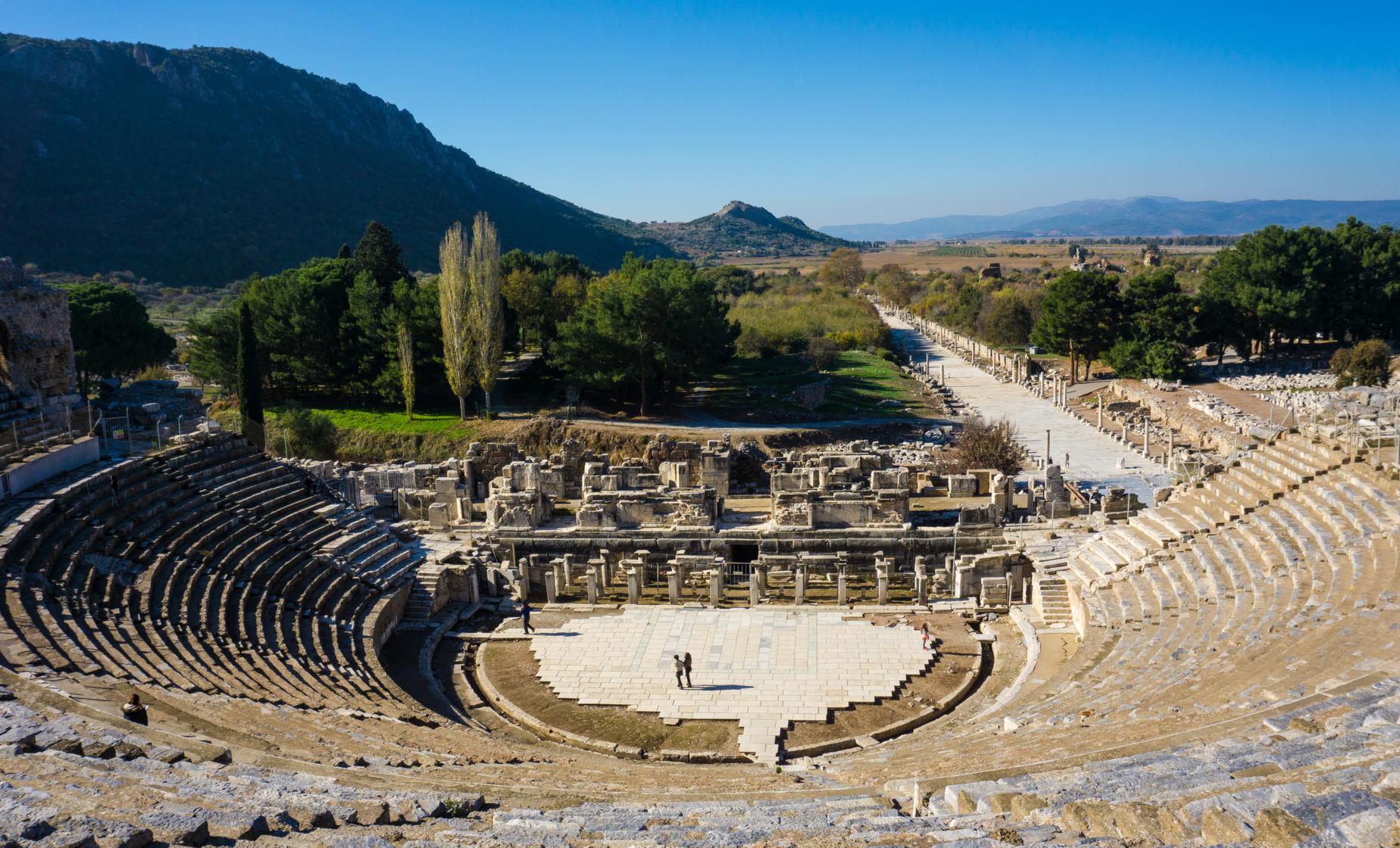
Cruise Ship PierMeet your professionally trained guide and drive to Ephesus, approximately 30 minutes from Kusadasi. Famous in antiquity for its Temple of Artemus during the years of the Roman Empire, the Greek port of Ephesus became the greatest city in Asia Minor. You will start your 90 minute Ephesus tour at the upper Magnesia Gate, and work your way down through the city, ending near the ancient Harbor.
Along the way, you will see the Forum, the Odeon, the Library of Celsus, Temple of Artemis, the Thermal Baths of Scolastika, and the Great Theater, built in the Greek era and reconstructed in the Roman period. With your skip-the-line access, you can fully enjoy these sites, which have played host to events as varied as Paul and his sermons to the Ephesians, to concerts by Sting, in part due to their remarkable acoustics.
You will walk along the Arcadian Way, where once Mark Antony and Cleopatra rode in procession. You will hear stories of Alexander the Great, the Virgin Mary, and many other famous visitors who walked the same marble streets that you are walking. As you depart the Ephesus site, you will be able to view the hilltop ruins of the Basilica of St. John in the distance, which was erected over his grave in the 6th century A.D. by Emperor Justinian.
Returning to the town of Kusadasi, guests will have the option to end their Ephesus tour in the shopping area, where they can attend a Turkish carpet explanation and explore the shops filled with jewelry, carpets, leatherware, and copper goods, or both. Turkish salespeople expect you to haggle and quite often you can get 10-15% off the listed price. Treat it as an adventure. The cruise pier is a 5-10 minute walk from the main shopping area.
Guests not wishing to attend the optional carpet shopping should stay on the bus and they will be taken directly back to the pier.
Standard
Moderate
Cruise Ship PierStarting from the port of Mykonos, enjoy a tour around the island from a different point of view, full of traditional and authentic images and experiences. Your first stop will be at a popular site offering photographic panoramic views of Mykonos town, a must-see for all the island's visitors.
Following the picture taking, visit the picturesque small port of St. Ioannis, an area named after a small church of great historical significance dedicated to Saint John ("Ioannis" in Greek). You will visit the church, along with the Saint's cell, home of the annual fair. The small port is the launching point for local fishing boats, protected from the island's strong north winds.
You will then head towards the Mykonos airport offering another photographic panoramic opportunity, this time on the airport's runway. If you are lucky, you will catch a plane, taking off or landing. After a few shots of the runway, you will make your way toward Ano Mera Village driving through the island's agricultural and livestock-raising areas. Ano Mera is best known as being one of the oldest, most quaint, and quiet villages found on Mykonos.
While at Ano Mera Village your guide will lead you through the village's colorful square and the monastery of Panagia Tourliani, built in 1542 and restored in 1767. You will have the opportunity to join a guide for a walk through the monastery chambers if you so choose. Entrance fees to the Monastery are 2 EUR per person.
After capturing the images of the Mykonian countryside and its lifestyle, you will visit the farm of the Mykonian Spiti, where an escort and the farm's superintendent will oversee your stay. Whoever wishes may also use the farm's tools and get involved with the farming work and tasks in cooperation with the superintendent. Take this opportunity to get closer to the domestic animals and the farm's traditional organic cultivation. A light snack will be offered to all visitors for 15 EUR, or you can choose the option of a light lunch for 20 EUR consisting of local products from the conventional farm itself.
Upon leaving the traditional farm, head over to Kalo Livadi, Kalafati, and Aghia Anna, the most distant and beautiful beaches in all of Mykonos for a few more photo opportunities.
To close out your tour, you will be driven back to your ship with lasting memories of the fantastic time spent on Mykonos.
Small
Moderate
Cruise Ship PierThe ancient city of Herculaneum was one of several cities, including Oplontis and Pompeii, that was destroyed when the then 800-year-old dormant Mount Vesuvius erupted in 79 A.D. Herculaneum was a thriving trading port thanks to its proximity to the Gulf of Naples and was more prosperous than its more famous neighbor, Pompeii.
Unlike Pompeii, Herculaneum was buried under 50 - 60 feet of mud and lava from several pyroclastic surges that ended up preserving a major portion of the city, with many buildings and objects completely intact. The wealth of objects includes 2000-year-old doors, windows, partitions, furniture, jewelry and money. Sections of Herculaneum are continuing to be unearthed today and the delicate work of securing the ancient city aims to make this increasingly more accessible for visitors, gradually allowing the opening to the public of the precious collection of artefacts which illustrate daily life in a Roman city in the first century AD.
Here's your chance to wander through one of the world's most famous archeological sites and see such landmarks as the house of the Deer, the house of Aristides, the Central Thermae bath houses and House Number 22 with its colorful mosaics of Neptune and Amphitrite.
Walk along stone paved roads, observe water pipes fashioned out of lead and much more as you imagine what the last few minutes of life were like for the remnant of residents huddled at the boat houses waiting for rescue from sea.
Herculaneum is smaller than Pompeii and can be experienced in 1.5 hours, despite its extensive excavation. Sign up today, bring your camera and get ready to see what life was like for those living in the shadows of Mount Vesuvius.